
A Complete Step-by-Step Guide to Finding the Right Keywords and Building Content That Actually Ranks in 2025
Table of Contents
Introduction
Imagine trying to open a restaurant in a city where you have no clue what people like to eat. You don’t know if they’re into pizza, vegan bowls, or Korean BBQ. You just throw something on the menu and hope they show up. That’s what creating content without keyword research looks like.
Keyword research is basically eavesdropping on the internet. It’s your way of figuring out what people are actually thinking, stressing about, and desperately searching for at two in the morning. It’s not about gaming Google with “magic words.” It’s about listening before you open your mouth.
And here’s the thing. In 2025, the way people search is messy. They don’t just type stiff little phrases anymore. They talk to Siri like she’s their therapist, they ask Google Assistant half-baked questions while brushing their teeth, they snap a picture of a shoe and expect the internet to tell them where to buy it. Search is more human than ever, which means keyword research has to be more human too.
Forget the old-school nonsense of cramming a phrase into a blog post until it sounds like a robot wrote it. That’s dead. Keyword research now is about understanding behavior. It’s about empathy. It’s about stepping into your audience’s shoes and asking, “What are they really trying to figure out?”
So here’s the deal. I’m going to walk you through keyword research the way I wish someone had walked me through it when I was clueless and thought SEO was just about repeating the word “laptops” fifty times. I’ll give you stories, examples, and the kind of advice you can actually use instead of theory that sounds smart but does nothing. Think of this as the no-BS survival guide to keyword research in 2025.
Step 1: Stop Thinking About Keywords. Start Thinking About People.
Years ago, when I started my first blog, I thought SEO meant cramming words like “best laptops” into my posts until the page looked like a ransom note. I remember staring at a competitor’s article and thinking, “Wow, they used the keyword ten times. That must be why they’re ranking.”
Spoiler: it wasn’t.
What I was missing was intent. Behind every keyword, there’s a person with a specific need. Someone searching “how to fix a leaking faucet” doesn’t want a 3,000-word history of plumbing. They want a quick guide, maybe even a video. Someone searching “best budget laptops 2025” is ready to compare options and might even be one click away from buying.
In 2025, Google is obsessed with intent. If your content doesn’t match the reason someone is searching, it won’t rank no matter how perfect your keyword placement is.
Pro tip- before you commit to a keyword, Google it. Look at the first page. If you see listicles and product reviews, it’s buyer intent. If you see how-to guides, it’s informational. That’s your compass.
Step 2: The Treasure Map Starts with Tools
You don’t need to spend hundreds of dollars a month on SEO tools, but you do need a compass. I still remember the first time I discovered Google Keyword Planner. It felt like I had found a cheat code. Suddenly I could see how many people were searching for “best sneakers” or “cheap hotels in Goa.”
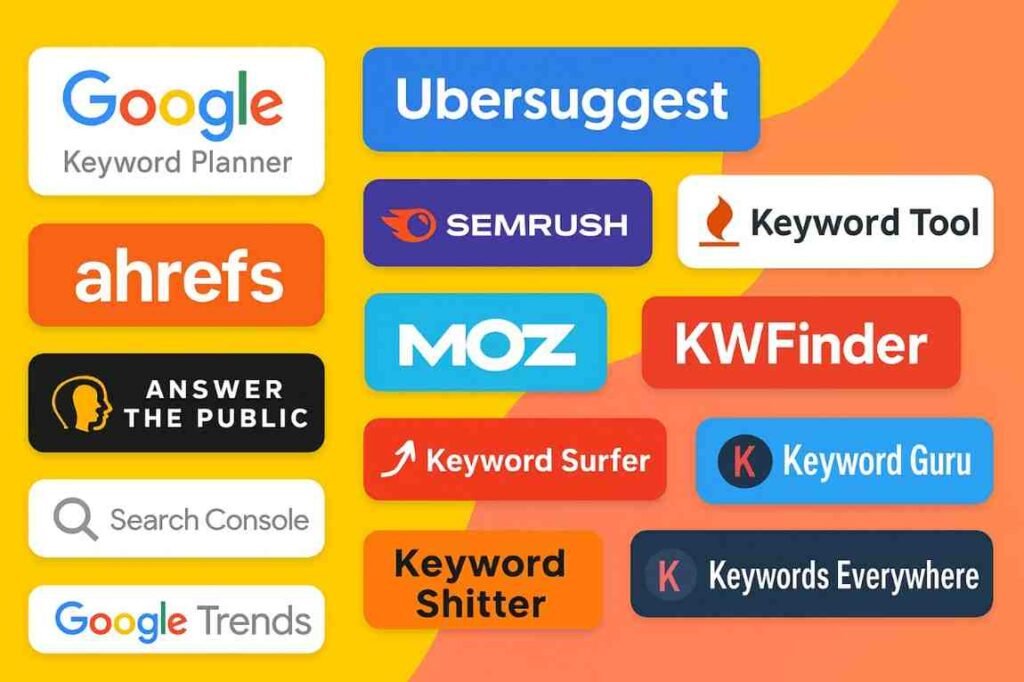
Today, you’ve got plenty of options:
- Google Keyword Planner – still free and still useful for volume and trends.
- Ubersuggest – my personal favorite for beginners because it’s easy and affordable.
- Ahrefs and SEMrush – the Ferraris of SEO tools. Pricey, but packed with insights like difficulty scores, competitor keywords, and traffic estimates.
- AnswerThePublic – shows you the exact questions people are typing into Google. It’s like eavesdropping on the world’s biggest brainstorm.
- Google Search Console – the underrated tool that shows you what you already rank for.
Here’s the trap though: beginners get stuck in “spreadsheet paralysis.” They collect hundreds of keywords but never create content. Remember, the point of tools isn’t to hoard data. It’s to make informed choices and start writing.
Step 3: Don’t Chase Shiny Objects. Go for Relevance.
I once made the mistake of chasing a keyword with 50,000 monthly searches. It was broad, competitive, and way out of my league. I poured weeks into creating the content, hit publish, and waited. Crickets. The only visitors I got were me checking my own post.
Then I tried a different approach. Instead of “SEO tips,” I went for “SEO tips for small businesses in 2025.” The volume was smaller, maybe 350 searches a month, but the traffic was laser-targeted. Small business owners found it, bookmarked it, shared it, and even reached out for consultations. That single article brought me more clients than the broad keyword ever could.
This is the power of long-tail keywords. They may not look sexy in terms of volume, but they bring you the right people. And relevance always beats volume.
Step 4: Learn From the Competition
Think of your competitors as free teachers. They’ve already done the experiments. All you need to do is study them.
Here’s my little ritual: whenever I find a keyword I like, I Google it and dissect the top ten results. Who’s ranking? What kind of content are they creating? Do they use videos, infographics, or just text?
Once, while researching “healthy breakfast ideas,” I noticed the top results were all giant recipe sites. But buried on page two was a tiny personal blog with just a simple list post. That was my signal. If a small blog could sneak in, so could I, with better formatting, photos, and recipes.
Use tools like Ahrefs or SEMrush to peek at competitor keywords, but never copy them blindly. Look for gaps. Maybe they cover “SEO for restaurants” but skip “SEO for local gyms.” That’s your opening.
Step 5: Think in Clusters, Not Islands
In 2025, Google doesn’t just reward individual pages. It rewards topic authority.
Here’s a story. I once wrote a post on “email marketing tools.” It ranked decently but never exploded. Then I built an entire cluster around it:
- One article on subject line strategies.
- Another on how to avoid spam filters.
- Another comparing free vs paid tools.
I linked them all back to the main “email marketing tools” post. Within a few months, Google started treating me as an authority on email marketing. My rankings improved across the board.
This is called the topic cluster model, and it works like magic. Your pillar post is the hub, and your supporting posts are the spokes. Together, they build authority.
Step 6: Blend Data with Gut Instinct
Here’s the truth nobody tells you: keyword research is part science, part art.
You can have all the numbers in the world, but sometimes the best keyword is the one that feels right. I once optimized a post for a keyword with just 90 searches a month. Everyone told me it was a waste of time. But that post exploded, because those 90 people had high intent. They weren’t just browsing—they were ready to take action.
So yes, use the tools, check the volumes, study the competition. But don’t ignore your gut. Ask yourself: would my audience actually search for this? Would I click on this if I saw it? If the answer is yes, trust it.
Step 7: Pay good Attention to Trends
The way people search is changing fast. Ten years ago, nobody was asking Alexa or Google Assistant for advice. Now voice search is everywhere. Instead of typing “best pizza New York,” people say, “Where’s the best pizza place near me right now?”
In 2025, you need to think conversationally. Optimize for questions, FAQs, and natural language.
And don’t forget Google’s SGE, the AI-powered search results that summarize answers. If you want to show up there, your content has to be clear, conversational, and structured to answer questions directly.
Visual search is also on the rise. People snap a photo with Google Lens and find products instantly. If you sell physical products, optimize your images with descriptive file names and alt text.
Step 8: Keep Your Keyword List Alive
Keyword research isn’t something you do once and forget. It’s more like tending a garden.
Check your Google Search Console every month. You’ll be surprised at the random queries you’re already ranking for. I once discovered I was getting impressions for “SEO for yoga studios” even though I had never written about it. Guess what my next blog post was?
Update your old posts. Add new keywords. Expand with FAQs. Remove outdated terms. Google loves fresh, relevant content, and your keyword list should evolve with it.
Step 9: Build a Simple System
Every time you find a new keyword, don’t just let it slip through your fingers. Toss it into your sheet. Treat it like a note to your future self. Because here’s the truth: there’s nothing worse than sitting down to write and staring at a blank screen like it’s mocking you. When you’ve got a list of ideas waiting, it feels less like torture and more like following a map you’ve already drawn for yourself
Step 10: Remember the Human on the Other Side
At the end of the day, keyword research isn’t about gaming Google. It’s about understanding people. If you lose sight of that, no strategy will save you.
Picture someone on their phone at midnight, frustrated, typing in “how to fix a leaking faucet.” They don’t want jargon. They don’t want fluff. They just want help.
That’s what keyword research is really about: empathy. Finding the words your audience uses, understanding their struggles, and showing up with answers that matter.
Final Thoughts
Keyword research in 2025 isn’t a numbers game. It’s not about obsessing over charts or chasing whatever keyword looks shiny this week. It’s about listening. Listening to the way people talk, the problems they’re trying to solve, and the exact words they use when they’re frustrated enough to Google it.
Don’t turn keyword research into some soulless routine. You’re not collecting baseball cards or filling out a spreadsheet for fun. You’re building a bridge. A bridge between what people need and what you can offer.
Google doesn’t care if you can repeat a phrase a hundred times. It cares if you can show up with something useful. So stop overthinking, stop hoarding, and start creating.
You’ve already got the map. Now it’s on you to pick up the shovel and dig.
This was just the beginning. Keep exploring by clicking here