
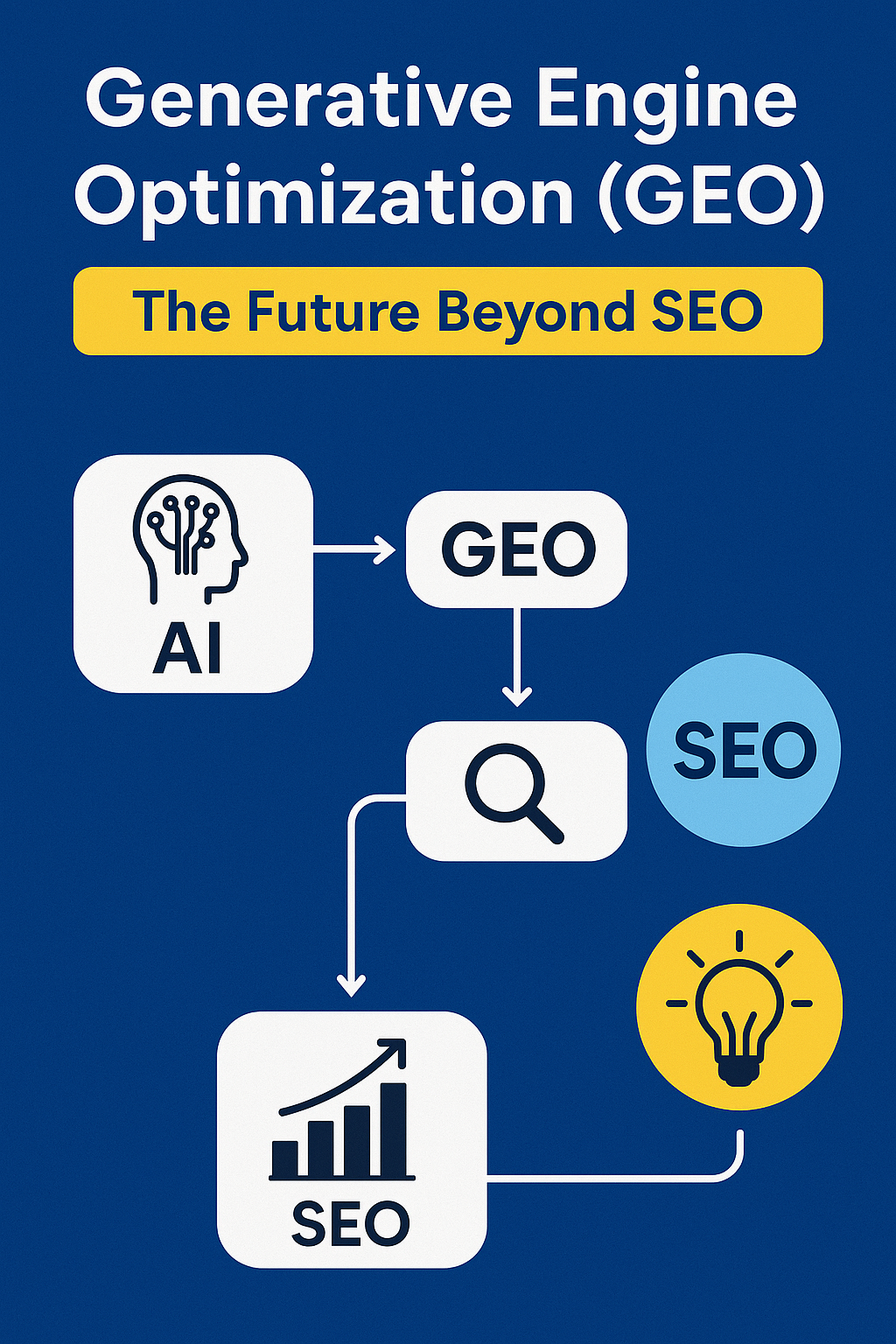
“Generative Engine Optimization is the next evolution of search.
It’s where AI-driven engines decide brand visibility beyond traditional SEO.”

Table of Contents
When was the last time you Googled something and actually scrolled to page two?
Chances are, never. Because now, even before you finish typing, AI-powered snippets, summaries, and answers greet you instantly.
Welcome to a new era of search.
One where search engines are transforming into “generative engines.”
And that’s where the buzzword of 2025 enters the room: Generative Engine Optimization (GEO).
It sounds futuristic, like SEO’s cooler, AI-savvy cousin. But GEO isn’t just another marketing fad. It’s a seismic shift in how people find information, how businesses get discovered, and how we all interact with the internet.
Let’s unpack it together.
From SEO to GEO: The actual scenario
For years, marketers swore by SEO (Search Engine Optimization). Write keyword-rich blogs, optimize metadata, build backlinks, do that right, and you climb Google’s ranks.
But here’s the problem:
- Search engines are no longer just indexing pages.
- They’re generating answers.
- And those answers are AI-curated summaries that may or may not include your carefully optimized webpage.
Think of Google’s AI Overviews, Perplexity AI, or ChatGPT’s browsing capabilities. They don’t show “10 blue links.” Instead, they generate human-like answers that feel conversational, quick, and personal.
So, if you’ve been spending thousands optimizing for traditional search but ignoring this shift, you risk becoming invisible. That’s where GEO takes the stage.
What is Generative Engine Optimization (GEO)?
Generative Engine Optimization (GEO) is the practice of strategically creating content so AI-driven search engines can find, interpret, and use it within their generated answers.
In plain English:
Instead of only writing for humans and Google’s algorithm, you’re also writing for AI assistants and generative engines.
The goal?
When someone asks a generative search engine a question, your content gets chosen as the “voice” of that answer.
If SEO was about “ranking on the first page,”
then GEO is about “being the chosen quote in the AI’s response.”
Why Should You Care?
Here’s a quick story.
A small wellness brand I know spent years building blog traffic through SEO. They ranked top 3 for “best herbal teas for anxiety.” But once AI Overviews rolled out, their organic clicks dropped by 40% in just 3 months. Why? Because Google’s AI now generates an instant answer and people stop scrolling.
Their years of SEO investment suddenly looked fragile.
This isn’t fear-mongering. It’s the reality: AI answers cut traffic from traditional search results.
But flip the script and it’s also an opportunity.
If you learn to master GEO, your content can be the trusted source that AI pulls from, delivering brand awareness at scale.
That’s a future worth fighting for.
The Anatomy of GEO Content
So what makes GEO content different from SEO content? Let’s break it down:
- Conversational, Not Robotic- Generative engines prefer content that reads naturally. If your blog sounds like it was written for a keyword bot in 2012, you’re out. Human-like storytelling, examples, and emotional resonance win.
- Fact-Rich and Credible- AI engines pull from authoritative sources. They crave statistics, expert quotes, case studies, and real data. If you can back your words with research, you become the reference.
- Structured for Machines- Clear headings, bullet points, FAQs, and schema markup help AI parse your content. Think of it as giving the engine a map.
- Depth Over Surface- Thin content doesn’t make the cut. Generative search engines reward in-depth insights—articles that genuinely teach, not just rank.
GEO in Action: What it Looks Like
Imagine someone asks Perplexity AI:
“How can small businesses prepare for generative search?”
Here’s what happens:
- The engine scans trusted websites.
- It pulls sentences that directly answer the query.
- It generates a cohesive answer and cites the sources.
Now, if your blog contains a clear, structured paragraph that explains exactly that, guess what?
You become the cited voice.
Not only does this put your brand in front of thousands of users, but it also builds instant credibility.
How to GEO-Optimize Your Content
Here’s a practical roadmap to get started:
1. Write for Humans First, AI Second
Don’t lose the soul of your content. Tell stories. Be brutally honest. Use metaphors. Make the reader feel like you’re talking to them over coffee.
A generative engine’s goal is to sound human. So if your content already feels like that, you’re ahead.
2. Target Questions, Not Just Keywords
Traditional SEO: “Best running shoes 2025.”
GEO: “What are the best running shoes for marathon training in 2025, and why?”
People now ask full questions and AI engines mirror that.
So structure your content to answer specific questions.
3. Add Authoritative Signals
- Cite reputable studies.
- Link to credible organizations.
- Showcase expert opinions.
Engines are trained to prefer content that feels trustworthy.
4. Use FAQs and Conversational Formats
GEO loves FAQs.
“People also ask” used to be an SEO hack, now it’s a GEO superpower.
Answering questions in Q&A format gives AI a ready-to-use snippet.
5. Leverage Schema Markup
Structured data still matters. By using schema (FAQ, HowTo, Article), you’re making it easier for AI systems to parse and cite your content.
6. Focus on Depth + Nuance
Anyone can write “Top 10 marketing trends.”
But GEO thrives on nuance. For example: “How generative AI is reshaping B2B lead nurturing in 2025.”
That’s specific, valuable, and rare—exactly what AI wants to showcase.
The Emotional Side of GEO
Let’s pause the technical talk.
For many creators, marketers, and business owners, GEO feels scary. SEO was already hard enough, now we’re told the rules are changing again?
I get it.
But here’s a comforting thought:
Every time technology shifts, storytelling still survives.
When radio came, books didn’t die.
When TV came, radio didn’t die.
When the internet came, TV didn’t die.
They evolved. And the ones who adapted thrived.
GEO isn’t here to erase SEO. It’s here to expand the playing field.
If you stay human, authentic, and adaptive—you’ll be fine.
GEO Success Stories (Early Signs)
- Tech blogs that optimize FAQs are already seeing higher visibility in AI summaries.
- Healthcare companies that publish expert-backed insights are being quoted in generative engines.
- Small e-commerce brands experimenting with question-based blogs are getting featured in AI Overviews, even against giant competitors.
The lesson? You don’t need to be the biggest—you just need to be the most helpful.
GEO vs SEO: A Simple Analogy
Think of SEO as a library.
Your goal was to get your book on the front shelf so readers could find it.
Now, GEO is like an AI librarian.
Readers don’t want to browse, they ask the librarian directly.
If your book has the clearest, most trustworthy answer, the librarian quotes you.
That’s the power of GEO.
The Future of GEO
Looking ahead, we can expect:
• AI citation rankings → Engines may start scoring how often you’re quoted.
• Voice search dominance → Imagine Alexa or Siri using your words.
• Personalized generative results → AI may prioritize answers aligned with user behavior.
The takeaway?
This isn’t a short-term hack. GEO will likely redefine digital visibility for the next decade.
Final Thoughts: The Human Advantage
Here’s the real kicker:
Generative AI is powerful, but it still struggles with originality, emotion, and lived experience.
That’s your competitive edge.
So when you write:
• Don’t just list benefits, share a story of when it actually helped someone.
• Don’t just state facts, explain how it felt.
• Don’t just optimize for keywords, optimize for human connection.
Because at the end of the day, generative engines may rewrite sentences, but they still need human truth to stand on.
And that truth? That’s you.
To read More Please click Here