
Why SEO in 2025 looks different
If 2024 was the year AI crept into search, 2025 is the year AI drives. Search behavior, SERP design, and ranking signals are all changing simultaneously. The playbook is evolving, but the potential is huge for marketers who move fast.
Table of Contents
Following are the 10 SEO trends informing results today, with actionable advice, people-first explanations, and new research to assist you in prioritizing your next steps.
1) AI Summaries are revolutionizing discovery, not replacing organic clicks
Google’s AI Summaries launched in the United States in May 2024 and came to 100+ countries by later that year. Google reports these experiences now reach over a billion people each month, and they have included more prominent source links so that people can click to publishers. What this means is your content continues to have to earn clicks, but now you also have to write keeping AI summarization in view. blog.google+2blog.google+2
What to do
- Respond to the main purpose in the initial 2 to 3 sentences, followed by depth below.
- Keep concise, well-named sections that are simple for AI to quote or cite.
- Address neighboring questions in brief, scannable sentences so your page can cover more versions of the question.
2) Position ranking still rules clicks despite AI factors
New 2025 statistics indicate position one organic takes around 39.8 percent CTR, position two around 18.7 percent, and position three around 10.2 percent on average results without any additional modules. The premium paid ad positions take an average of 1 to 2 percent CTR, while AI Overviews that contain links can compete with positions three to five depending on the situation. The moral is straightforward, being at the top remains important.
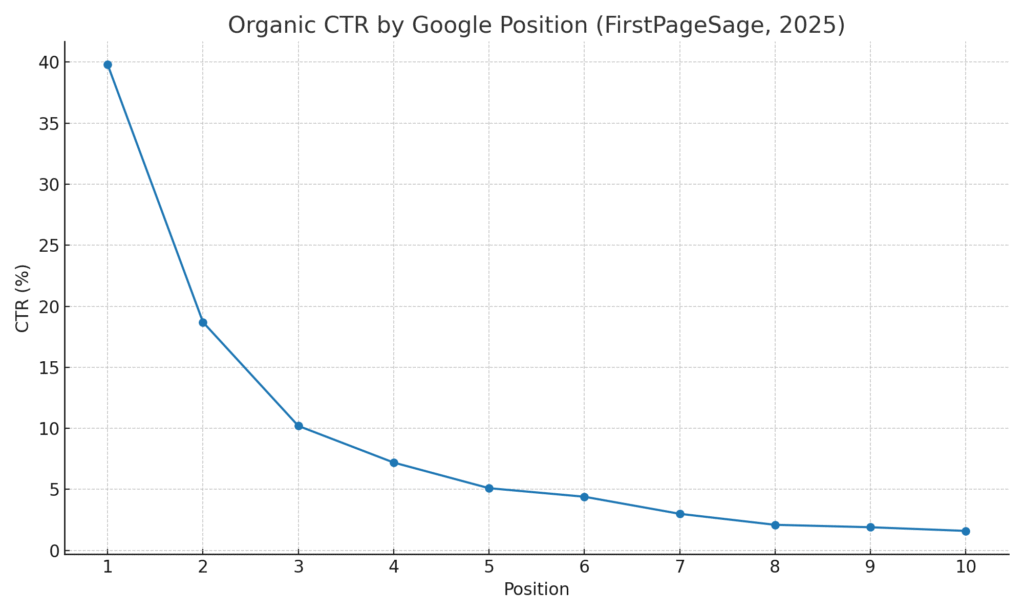
Research snapshot: CTR by position in 2025
What to do
- Target a small cluster of highly relevant keywords per page, don’t seed a single page with competing intents.
•\tMake clicks with attention-grabbing title tags and meta descriptions that offer an unmistakable benefit, then deliver it right away in the introduction.
3) Mobile-first is now mobile-dominant
Across the globe, mobile contributes to about 59.3 percent of web usage compared to 40.7 percent for desktop as of July 2025. Search behavior mirrors that skew and Google persists in giving preference to mobile page experience in the assessment of results. If your website is not yet “mobile first,” you are leaving traffic and conversions on the table.
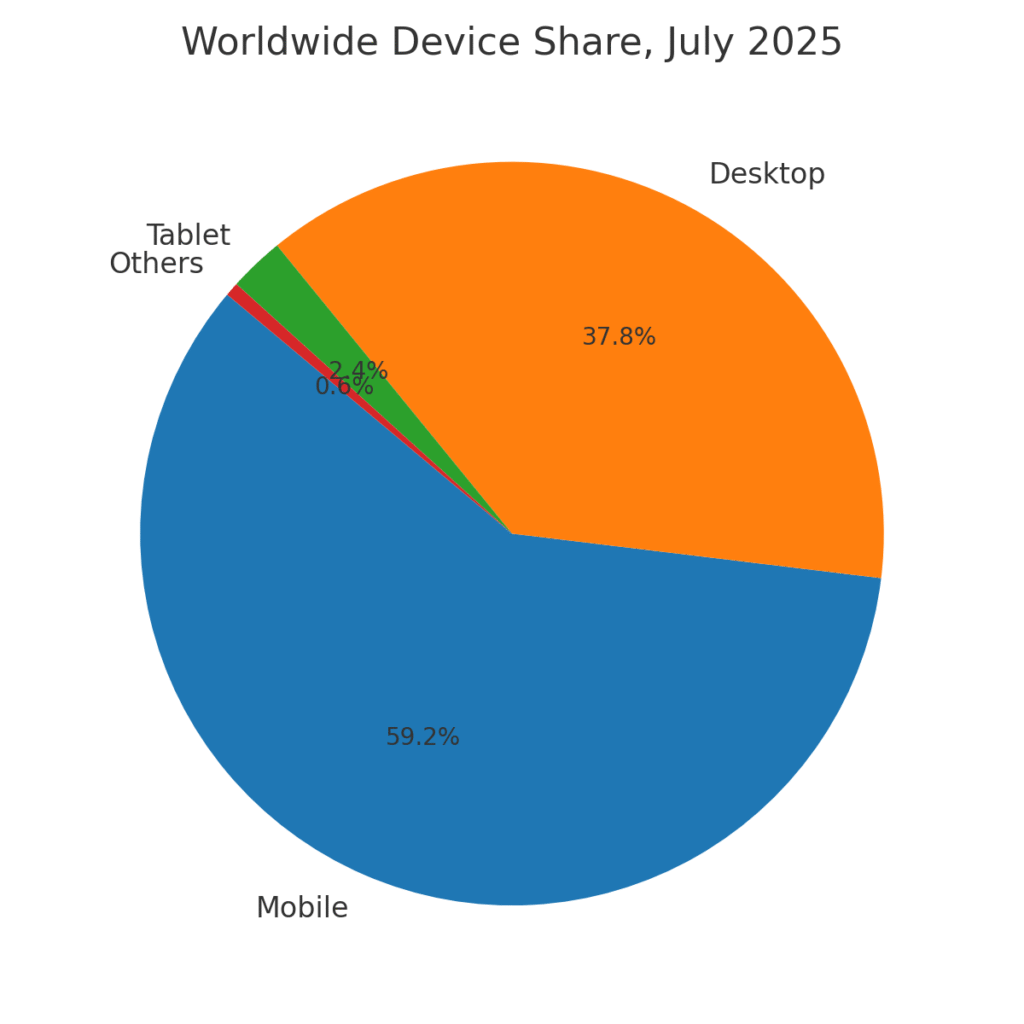
https://gs.statcounter.com/os-market-share/mobile/worldwide
What to do
- Design for small screens first, then enhance incrementally. Read more on importance of mobile optimization here
- Leave primary CTAs above the fold, reduce tap targets close to one another, minimize layout shifts.
4) Core Web Vitals, enhanced with INP, isolate the fast from the rest
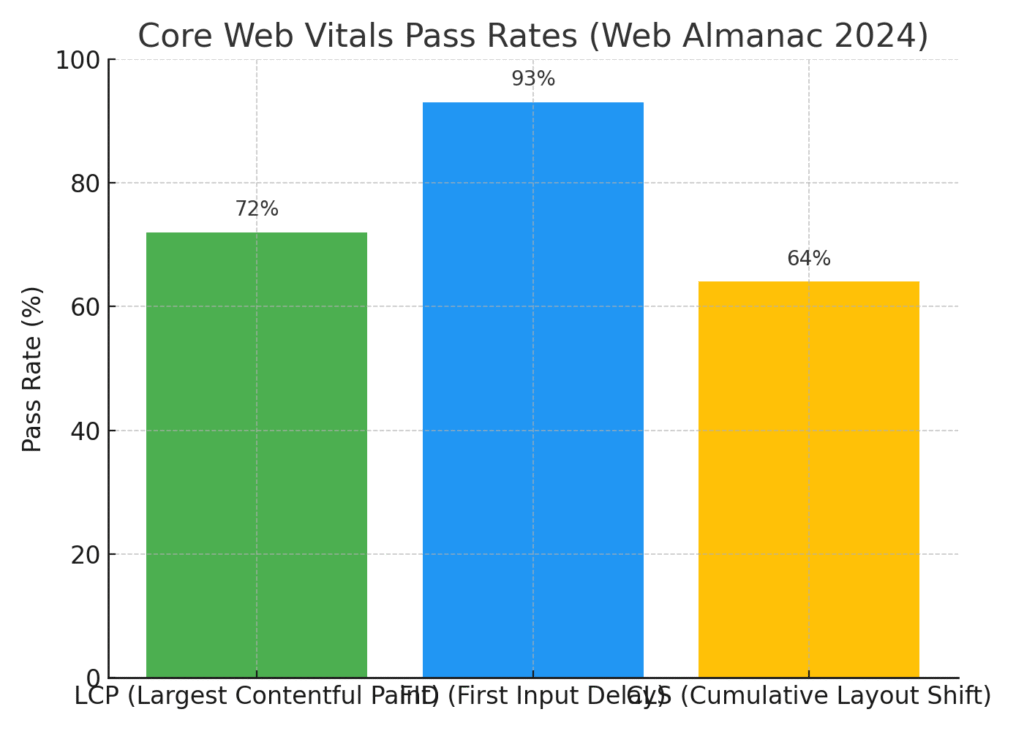
In 2024, First Input Delay was officially replaced by Interaction to Next Paint (INP), a harder and more robust interactivity metric. The Web Almanac reveals that on mobile, the percentage of pages passing Core Web Vitals is around 43 percent under INP compared to 48 percent under the now-older FID, while desktop is about 54 percent. Passing CWV is not just a nice-to-have anymore, it’s a baseline that aligns with improved engagement and, increasingly, visibility.
Research snapshot: Core Web Vitals pass rathttps://almanac.httparchive.org/en/2024/performancees
What to do
- Treat INP as a product bug, not only a dev task. Split up long tasks, don’t use heavy third-party scripts, and deliver smaller JavaScript bundles.
- Enhance Largest Contentful Paint through server-side rendering or streaming, optimized images, and early hints or preconnects where necessary.
5) Search engine blend stable at the top, but competition on desktop is real
Google still leads the world on all devices, notably mobile where it is well over 93 percent share. On desktop, things are more apparent, with Bing frequently over 11 percent in global share. For most companies, Google is still the primary acquisition channel, but monitor audience pockets where Bing or another engine is overrepresented, such as Windows-dominant enterprise environments. StatCounter Global Stats+1
What to do
- Monitor engine as a facet of analysis, not merely “Organic Search” in bulk.
- Experiment with subtle title differentials for Bing, as its snippet treatment and CTR trends may not be the same as Google’s.
6) Structured data is the glue for AI summaries and rich results
As AI Snippets and Overviews reveal more formal responses, schema is now a requirement for eligibility and proper citation. Mark up FAQs, how-tos, product info, authors, organizations, and video, then validate and watch for mistakes. The reward is richer listings, more accurate citations in AI summaries, and improved long-tail question query matching. blog.google
What to do
- Embed Organization, WebSite, and Person schema to define entity relationships.
- Target FAQ, HowTo, Product, Recipe, VideoObject, and Article based on your content.
7) Topical authority is the antidote to fragmented SERPs
With map packs, videos, PAA boxes, and AI Overviews all competing for rank space, Google still relies on who is the most complete and credible on a topic. That makes clusters and linking within your site more important than ever. Sites that deep dive and bridge the gaps make it simple for both searchers and AI systems to cite and trust them.
What to do
- Develop topic clusters with an evident hub page and 8 to 15 solid supporting posts.
- Interlink using descriptive anchors, and maintain a uniform content design system within the cluster.
8) Content design trumps content length
Longer isn’t necessarily better. Users scan on mobile, and AI picks out brief answers initially. You still require depth in order to rank, but you require clearer structures to gain engagement. Consider short paragraphs, descriptive subheads, comparison tables, and scannable checklists. Include video or interactive content where they truly enhance understanding, then condense with a “Too long, read this” box close to the top.
What to do
- Place the answer at the beginning, followed by context and evidence. Employ callouts for important steps or figures.
- Build a pattern library for your blog elements so they are consistent and simple to reuse.
9) Video and short-form clips drive search demand and brand queries
Shorts, Reels, and TikTok are conditioning users to anticipate short visual answers that frequently result in branded searches down the line. Make your videos search-friendly by matching titles to popular how-to and comparison questions, adding chapters, and embedding videos into applicable articles. This increases dwell time and provides another avenue for your page to be referenced by AI Overviews.
What to do
- Publish supporting short-form clips for each significant article, then embed them.
- Use transcripts for accessibility and additional indexable text, and markup with VideoObject schema.
10) Measurement is shifting to events and journeys, not sessions alone
With cross-device behavior and privacy shifts, single-session attribution continues to become more murky. Marketers who model journeys with events, engaged-view video measurement, and micro-conversions will make more informed content bets. Connect your SEO objectives to real-world outcomes, such as demo requests or add-to-cart initiations, rather than pageviews.
What to do
- Measure scroll depth, copy events, table interaction, FAQ toggles, and video chapter plays.
- Create comparison dashboards by topic cluster so that you can view which themes actually generate pipeline.
Bonus insights from the data above
- Position still dominates. The CTR chart indicates a step change between positions one and two, and once more between three and four. If you are in position four or five, a few on-page and link tweaks can pay out in disproportionate ways. First Page Sage
- Mobile experience is the default. The device share data reinforces why page structure, font size, tap targets, and lazy-loading choices are not minor details. They are how people actually experience your brand. StatCounter Global Stats
- INP is the sleeping metric. Most teams tidied up LCP and CLS in the past two years, but INP reveals JavaScript chubbiness and main-thread long tasks. Solving it has a tendency to boost conversion and retention along with rankings. almanac.httparchive.org
Actionable 2025 checklist
Use this handy list to reconcile your roadmap:
1. Update your top 20 dollar pages with answer-first introductions and more concise subheadings.
2. Add or refresh schema for Article, FAQ, HowTo, and Video as appropriate.
3. Enhance INP by shipping less JavaScript, delaying non-essential scripts, and splitting long tasks.
4. Redo titles and descriptions to commit to a specific result, then deliver on that commitment in the first paragraph.
5. Construct or develop two topic clusters where you have a rightful claim to triumph, connect them with explicit anchor text.
6. Develop short-form video companions for every new guide and nest them.
7. Monitor events indicative of actual engagement, then report in clusters instead of per post.
8. Localize to engines and audiences that are relevant to you, pay attention to desktop niches where Bing performs better. StatCounter Global Stats
References and data sources
- FirstPageSage, “Google Click-Through Rates by Ranking Position in 2025,” revised May 28, 2025. Organic position figures and comments on the impact of AI Overviews on CTRs. First Page Sage
- StatCounter Global Stats, “Desktop vs Mobile Market Share Worldwide,” July 2025 snapshot. StatCounter Global Stats
- StatCounter Global Stats, “Mobile Search Engine Market Share Worldwide,” July 2025 snapshot. StatCounter Global Stats
- StatCounter Global Stats, “Desktop Search Engine Market Share Worldwide,” July 2025 snapshot. StatCounter Global Stats
- HTTP Archive, Web Almanac 2024, Performance and CMS chapters, Core Web Vitals and INP context and pass rates. almanac.httparchive.org+1
- Google Blog, AI Overviews announcements and international expansion updates. blog.google+2blog.google+2
Final thought
SEO in 2025 is not gaming the SERP. It’s being the easiest, quickest, most informative answer in your space, presented in a human- and AI-readable format. Do that on a consistent basis, and the above trends swing in your direction.