
Discover the most common beginner digital marketing mistakes and learn how to avoid them for better results and faster growth
When I first waded into digital marketing back in 2018, I recall being much more enthusiastic than equipped. I had just created my first blog and spent two nights awake crafting a shiny logo and writing a couple of social media updates. In all honesty, I felt that when I clicked “publish”, traffic would simply pour in like some magical tap had been turned on.
What really happened?
I refreshed-checked Google Analytics at least 20 times a day… and the number “0” glared back at me every single time. For three whole weeks.
The reality is, digital marketing is extremely powerful—but only when implemented with strategy.
In the past couple of years (and a few agonizing blunders later), I’ve found that newbies tend to make the same old pitfalls. The best part? Most of them can be avoided if you know they exist upfront.
So let’s get started on the top 7 digital marketing faux pas beginners can avoid, and most importantly—how to avoid them.
Table of Contents
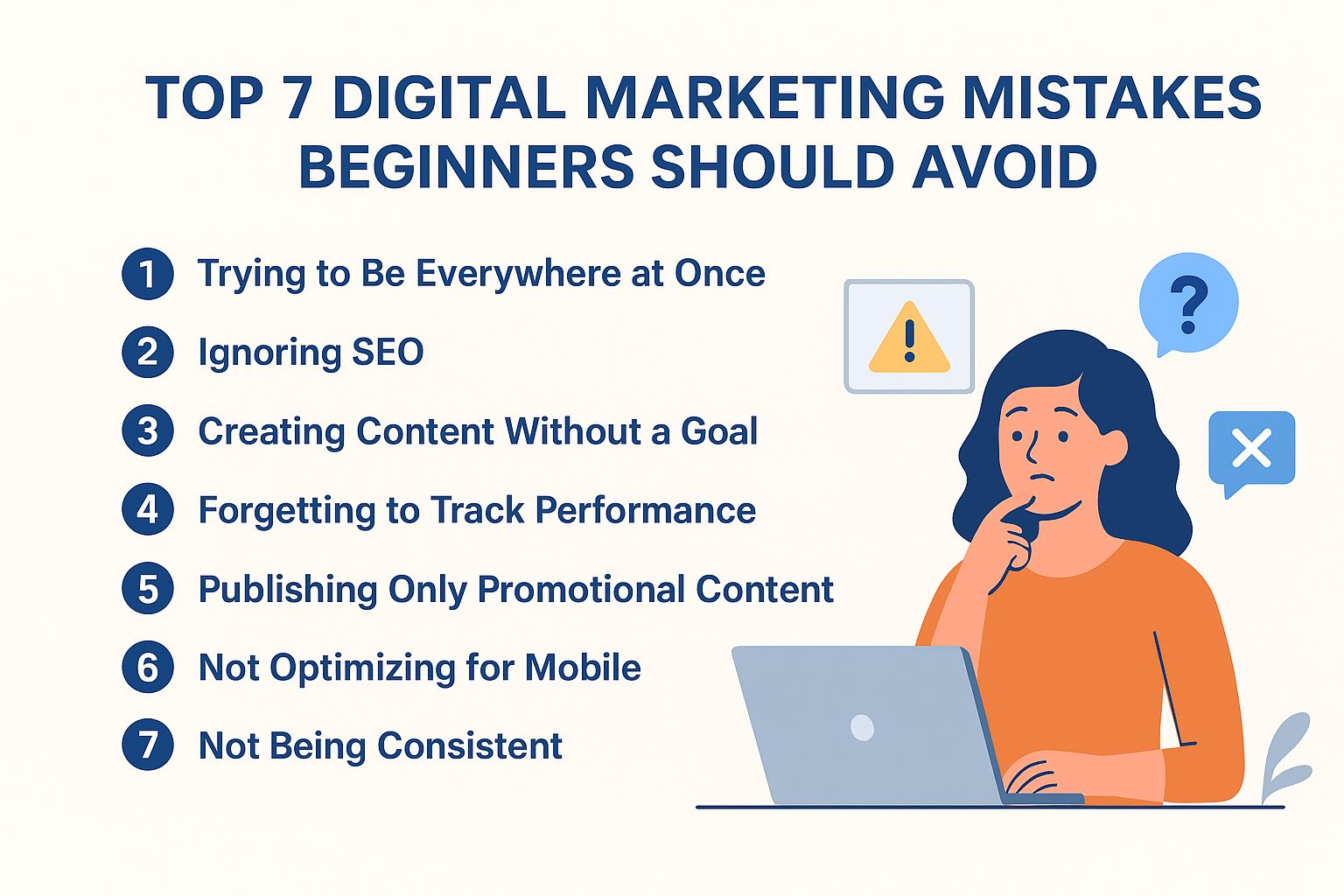
1️⃣ Attempting to Be Everywhere at Once
This is most likely the most prevalent error newbies make: opening accounts on all social media platforms they can imagine – Instagram, Facebook, LinkedIn, X, Pinterest, YouTube and even Reddit – within a week.
It makes absolute sense theoretically. In practice, you have diluted yourself too much and created subpar content for all platforms.
The correct approach:
Begin with only one or two platforms where your crowd already hangs out. Conserve your energy there, discover what resonates and establish consistency. Once you’ve established traction and a rhythm of content, you can gradually grow.
Gig tip: You can also use Google Trends or AnswerThePublic to locate where your target crowd spends most of their time.
2️⃣ Ignoring SEO (Search Engine Optimization)
SEO tends to sound too techie, so most newbies just avoid it.
But unless your blog is search-engine-optimized, even outstanding content may never be found.
To keep it simple, apply a few fundamental SEO techniques:
- Have a clear main keyword in your title and organically in the article (e.g. “digital marketing tips for beginners”)
- Structure content into correct headings (H1 for the primary title, H2 and H3 for subheadings)
- Create a brief and informative meta summary
- Link to other articles or pages on your site (internal linking)
Even doing just these four things will help your chances of appearing in search.
3️⃣ Producing Content Without Purpose
Many new content creators create content because “they need something to post”. That results in random topics, confusing messages, and no clear goal.
Before publishing anything, ensure you have a clear idea of three things:
- Who you want to reach (your audience)
- What problem you’re solving (the value you’re offering)
- What you want the reader to do next (your call-to-action — e.g. leave a comment, sign up, download something, etc.)
When you have the audience, their pain point, and the desired action, the whole piece ends up being much more targeted and valuable.
4️⃣ Omitting to Monitor Performance
This is something I did wrong for nearly a whole month. I wrote 12 blogs and never checked which one was actually working.
The outcome?
One of my posts was quietly climbing Google’s search rankings and I never even realized it — so I never updated or optimized it, and it never made it to page 1.
Why tracking matters:
It assists you in knowing what topics people are interested in, what keywords drive traffic to your site, and what format works best (e.g. list posts, guides, stories). Merely looking at Google Analytics and Google Search Console weekly for 10–15 minutes can provide you with insights for your next posts.
5️⃣ Posting Only Promotional Stuff
Starters want instant results, so they post offer after offer… and are confused as to why people lose interest.
People come online to learn, solve problems, or be inspired. Constant sales messaging drives them away.
A better approach:
Build trust by first creating helpful, educational, or entertaining content. Once you’ve built that trust, mix in relevant promos.
Think of it this way:
- Most of your content should help your audience
- Only a small portion should promote your products or services
For instance, rather than posting “Buy our SEO tool” each week, create a post with the title “5 Free Ways to Enhance Your SEO in 2024” and include your tool as one of the suggestions at the end.
6️⃣ Not being mobile-optimized
Over 60% of website visits are now done on mobile phones. That means your site needs to look awesome on a small screen — not just a laptop.
Check the following:
- Text large enough to be read without zooming
- Buttons and links easy to tap
- Images resize correctly and don’t overlap
- Pages load fast (compress or resize images if they’re too large)
If in doubt, use Google’s free “Mobile-Friendly Test” to scan any page of your website and see what needs fixing.
7️⃣ Not Being Consistent
Consistency is perhaps the most under-estimated area of digital marketing.
Posting every day for a week and then vanishing for two weeks confuses your audience as well as the algorithm.
It’s not the aim to post daily — it’s to post consistently.
Posting even one great post weekly can gain speed if you keep it up in the long run.
Pro tip:
Develop a mini content calendar. Schedule two weeks of content ahead of time (topics + posting dates). It eliminates procrastination and holds you accountable.
Final Thoughts
Digital marketing does not pay people for attempting to do it all.
It pays people for doing the right things repeatedly.
Steering clear of these 7 newb errors will place you in front of most newbies right away and provide you with a strong foundation to develop further.
In all honesty, if someone had reminded me of these during my first month, I would have saved myself months of experimenting.
To Read more Please click Here
Hi, this is a comment.
To get started with moderating, editing, and deleting comments, please visit the Comments screen in the dashboard.
Commenter avatars come from Gravatar.